
The OmniTI Process
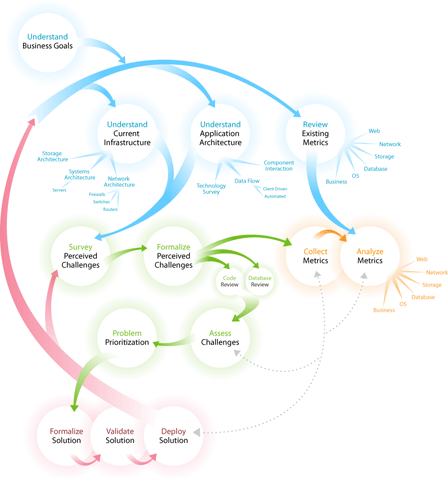
1. Understand the business
Understanding the business is all about developing a consistent and articulate description of what is really important and what it means to succeed — an understanding to which all stakeholders accede. The first step of the OmniTI Process is about understanding the goals of the business in sufficient clarity to make informed decisions throughout all other steps.
It’s the simple things that make the difference. For example, we make a point to understand the mission statements of our clients. It is just as important for us as it is for them to make sure every action taken is something that progresses them on the path to fulfill their mission.
~ Leon Fayer, VP of Business Development
2. Define objectives
No matter the size of the project, we must define clear and understandable objectives. Formalizing objectives in both business and engineering terms allows us to translate existing challenges into clear deliverables with concrete plans of attack. The success of both large multi-disciplinary projects and small surgical exercises hinge on understand what that success looks like and a clear definition of when it is achieved.
3. Perform analysis
Continuously collecting and reviewing metrics about all the tasks at hand is of paramount importance to staying on time and on budget. Success is only speculative until we can demonstrate that actual progress matches expected progress.
4. Achieve goals
Providing a solution to a problem is not as simple as fixing bugs, hacking code, or deploying new servers. In order to a achieve our goals, we make sure that we know where we are going and when we've arrived. This ensures that the solution delivered actually addresses the problem at hand and/or succinctly defines a new one.
The OmniTI Process
Opinion
OmniTI has collected a wide-ranging and unique set of professionals in many areas of web software architecture and development. If you have a formidable problem with your web application performance, they can solve it.
~ Andrei Zmievski, Core Developer, PHP.
